

We all use the media every day. When we turn on the radio on the way to work, when we read the newspaper with the coffee at noon, when we use public transport on our phones or when we turn on the TV at night. At any time, anywhere, we have them at our disposal. Although in recent years the habits and tools of information collection have been changing, the media continue to play an important role and place in the lives of citizens of all generations. That is why the media in Basque are essential, because they allow our language to be heard, read and visible in everyday life.
In recent years, the media in Basque and the productions in Basque made in the Spanish media have been developing, but they have had to face several challenges. When the WFP created a working group that brings together the media of the territory, it became clear that the media of the territory would have a great need to hire professional Basque journalists. This was therefore a challenge that had to be answered in the priority: Training of Euskaldunes to acquire knowledge of the territory of the Northern Basque Country and competences to be a journalist.
To respond to this need, the WFP held meetings with three universities: The public university present in the Northern Basque Country is the University of Pau and Aturrialde (UPPA); the University of the Basque Country/Euskal Herriko Unibertsitatea (UPV/EHU), which proposes a Basque journalism license; and the only journalism school in the Nouvelle-Aquitaine region, the Bordeaux-Aquitaine Journalism Institute (IJBA), attached to the Bordeaux-Montaigne Public University (UBM).
The University Diploma was chosen as two years of professional training in alternation, with the participation of the three universities, IJBA, UPPA and UPV/EHU. In addition, Afdas was committed to taking over the funding of the training, but the media involved in the project had to pay the students’ fees. Aware of the fragile economic situation of the media in the North and in order to support the private media, WFP decided to offer a grant of € 8,000 for each student hired. And so it has been. in September 2023, 8 private and public media and 10 students participated in the training. Among them, Kanaldude TV, Euskal Irratia, Antxeta Irratia, Kazeta.eus and Iparralde Hitza, which work entirely in Basque. In addition, the newspaper Mediabask, the public television France 3 Euskal Herria and the public radio station ICI Euskal Herria have also participated in the experimentation. Whether in the written press, radio or television, in the associative, private or public, this shows that all the media in the North needed a new generation of journalists. It should not be forgotten that at the beginning of the training, EiTB television and the weekly Herria hired a student for each of them. But in both cases, due to the personal reasons of the students, they had to leave at the beginning of the first course. Of the 12 students who signed the contract at the beginning, 10 continued with the aim of acquiring skills in three areas: Basque, the profession of journalist and territorial knowledge.
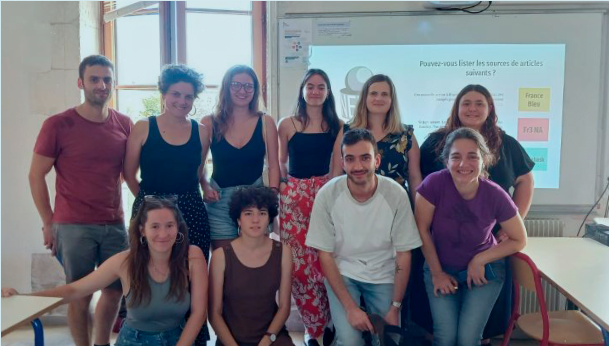
Two years later, the time came for experimentation. There was a need to evaluate a device driven and coordinated by WFP. Therefore, it was necessary to carry out a study whose results, shared with the media and unbiversities, were aimed at achieving different objectives and making decisions. First, share the study on experimentation and agree on a common reading. This allows us to measure the need to repeat experimentation from the same bases. And if the need arises, then agree on deadlines and conditions.
To carry out this analysis, the WFP has sought to bring together the perspectives of all students and participants. For this reason, we have started the study by collecting the opinions of the students. The students answer an online questionnaire. After analyzing each one’s answers, we meet with them one by one to understand their observations and deepen their reflections. This has allowed us to identify the strengths and weaknesses of the two-year training. To give you an example, there have been several notes on logistics. From the point of view of the pedagogical model of training, the involvement, collaboration and attraction of three universities in the same diploma is very enriching. But to be in class, the students had to travel through three different campuses located very far from each other: Mainly in Bayonne, but also in Bordeaux and Bilbao. And it hasn’t always been easy to travel and find a place to live, especially in Bordeaux. And at this time when the students were questioned, when the training had not yet been completed, there was also a great concern: most of the students had no certainty about the contract they could get the day after the training. It was very difficult for them to understand this, especially because the university diploma was organized to respond to an identified need. On the contrary, in general, the vast majority of students were very satisfied with the relationship they had maintained over the two years with the person in charge who had adapted to them in the medium, with the help and attraction (they valued an average of 8.1 / 10) and with the content of the theoretical training (7.4 / 10 on average).
After interviewing the students, we met with tutors and/or managers of the media students. Experimentation, since it was necessary to clarify whether or not it had the capacity to respond to the need identified by them. We have measured whether the training acquired by the students over two years met the needs of the media in Basque in the Northern Basque Country, as well as the quality of their relationship with the different universities, among others. Some of the conclusions drawn from these interviews are that the media, when hiring alternate students, have not only made an economic investment: it is necessary to assign a responsible person to the student, train him in the peculiarities of the medium, integrate him into the work team and give him the keys to be autonomous. But they point out that it has been necessary and, in some cases, the presence of the new generation has helped to enrich the editorial offer of the media. In general, they emphasize that thanks to this training a new dynamic has been created, which has also been confirmed by the universities.
Finally, we have come to the universities one by one. In addition to the development of the competences of the students and their relationship with the media, we have referred to the agreement and agreement reached in 2023 for the materialization of the training, as well as the benefits that the collaboration between the three universities has brought to each one. It is not a simple exercise to collaborate in the framework of training between universities with different realities, public and educational models.
To cite some of the results of Bilana, it can be said that, in general, the universities, media and students who have participated in the experimentation are satisfied. The students have had the opportunity to improve the level of the Basque language and have been aware of the importance of the quality of the Basque language in the media in Iparralde. They have developed competencies to practice their work as journalists, through modules worked in classes, thanks to the knowledge shared by professional journalists who have approached the classes, and also thanks to the experience acquired working in the company with a lot of dedication. They have also had the opportunity to acquire knowledge in the geographical, historical and socio-political knowledge of Euskal Herria and the territory of Iparralde, although in this area some people were interested in acquiring more teachings.
Beyond the content of the university diploma program, other elements have been questioned within the framework of the project. The criteria for the selection of students and the process followed for their selection have been discussed. The rhythms of alternation between study and work periods and, in general, the calendar itself have also been highlighted, due to various observations and concerns highlighted by the students. Finally, the data mentioned is the professional future of the students. Finally, among the ten students who have participated, nine have shown their intention to work as journalists. The five have had the opportunity to continue in the medium in which they have been trained. One of them remains in the public, the other in private only in Basque or in both languages. Although a sixth student does not have the possibility to continue in his medium after the alternation, he has signed a contract in another of the French Basque Country. As a result, the day after the training, six out of ten students work as journalists in a Basque media outlet in Iparralde that needs to have knowledge of the Basque language and the territory.
All participants have recognized that experimentation has been positive and that it has been an appropriate instrument to respond to an urgent need. Beyond the positive observations and assessments of students, media and universities that the study has made public, the figures show this: 60% of students leave training and currently work in a Basque media in Iparralde, and journalism studies do not reach such high proportions. But to respond to the need to create a quarry of young and Basque journalists in Iparralde, although the need to repeat the university diploma is clear, it will not be at the beginning of the next course. On the one hand, because the needs are no longer the same, in a territory where about forty journalists who work in Basque work, after a university diploma with ten formats of young journalists. And on the other hand, because the economic situation of the media has become fragile and the forecasts are not a sign of improvement.
Therefore, in the coming months we will analyze the deadlines in which we will bring together the media of Berritz Iparralde and the three universities around the table. to repeat the experimentation in the September 2027 course? Who knows? The media will communicate their needs and the Public Entity of the Basque Country will adapt to them.