


On the occasion of the 30th anniversary of the Global Media Monitoring Project (GMMP), coordinated by the World Association for Christian Communication (WACC), the seventh global monitoring was held on May 6, 2025, in which the presence and role of women in the media is measured. in 2020, the media of Hego Euskal Herria were included for the first time in the sample of the Spanish State and based on this, a group of researchers from the UPV/EHU formed the sample offering results at the level of Euskal Herria. Five years have passed since then, and although the investigation was carried out in a very special situation, which was postponed to September within the framework of the COVID pandemic, we had the opportunity to outline what the presence of women in the Basque media was like. In this case, in addition to taking a photograph of how women appear, the researchers have had the opportunity to compare if there have been changes.
Universities, communication associations, media and activists around the world collect data through voluntary work on a specific day that very few people know before, which is kept hidden to prevent the media from making apparent changes. Five research professors from the Departments of Audiovisual Communication and Advertising and Journalism of the University of the Basque Country have participated in this data collection, coordinated by Arantza Gutierrez Paz, and in addition to the sample of Basque media requested within the measurement of the Spanish State, applying the same methodology, we decided to extend the measurement to other media to be able to compare them with the results obtained at international level.
in 1995, the Beijing Declaration and Platform for Action established that, on the basis of equality in all spheres of society, the empowerment and full participation of women in decision-making and the process of empowerment are essential for the achievement of equality, development and peace. In particular, the Declaration, in section "J", set the following targets for women and the media: “Strategic objective J1, to promote women’s participation in expression and decision-making through the media and new communication technologies. Strategic objective J2, to promote a balanced and non-stereotypical image of women in the media” (United Nations, 1995, 170).
Previously, in 1994, feminist media activists, experts and communicators gathered in Bangkok decided to organize a day in early 1995 to monitor all media and use the data as a basis for analysing where women were and where they were not. Media monitoring was identified as one of a series of strategies that allow the democratization and decentralization of the media, as well as to contribute to the promotion of forms of communication that may question the patriarchal nature of the media (Macharia, 2023).
Subsequently, the Beijing Platform for Action established media monitoring as a strategy to achieve strategic objective J1. in paragraph 242, NGOs and media professional associations were encouraged to “establish media observation and consultation groups with the media to ensure that the needs and concerns of women are adequately reflected”1.
The GMMP has evolved and every five years since 1995 takes a snapshot of the key dimensions of gender equality based on the news. Over the course of thirty years, the GMMP has built data from 160 countries. While the global media landscape has changed drastically—from the incipient digitization of early newsrooms to the use of today’s Artificial Intelligence—the place of women has not changed.
In addition to the media with the highest number of audiences at the state level, in recent years media from the regional sphere have been incorporated with the aim of obtaining a more accurate photograph. In fact, in the last monitoring, La Voz de Galicia and TVG have been included for the first time in the sample of 2025. in 2020, the media of Hego Euskal Herria, those of Araba, Bizkaia, Gipuzkoa and Navarra were included for the first time. Therefore, since the measurement of the media with national dissemination could give a partial image, it was decided to include those that are rooted in certain nations or regions, as well as those that use an official language other than Spanish.
1. Gender studies in communication in the last five years in the Basque Country
In the article that analyzed the results of the 2020 monitoring carried out for the first time in the media in the Basque Country2 (2025), we made an extensive list of the communicative research carried out in the Basque Country from a gender perspective; in this we will expose the new lines of research that have been disseminated from there, as well as the main publications, since it is evident that research in the field of communication has multiplied the analyses that incorporate the feminist perspective.
The treatment of violence against women is a line of gender studies, in this sense we have the works published by the Gure Iker research group of the UPV/EHU: The media coverage of gender-based violence killings in the Basque Country has been analyzed, as well as the need to implement self-regulation codes (Ainhoa Novo-Arbona et alter, 2023). Along the same lines, María Gorosarri-González (2025) proposed an instrument to measure how the Basque press explains male violence as a form of media torture: In the article entitled Multimedia approach to media attention. The author himself is the author of a study that includes a conceptual approach and categorization of feminist journalism (2024).
For his part, Itxaso Fernández Astobiza defended his doctoral thesis March 8 in the press of the Basque Country: interpretive frameworks and characteristics of the contents in 2021. In this study, the press of Hego Euskal Herria analyzed, over a period of 40 years (1978-2018), its journalistic coverage of March 8 and the image it has built around the Basque Feminist Movement, based on the analysis of eleven newspapers from different ideological fields.
Similarly, researchers María Ganzabal Learreta, Koldo Meso Ayerdi, Jesús Pérez Dasilva and Terese Mendiguren (2023) have analyzed journalism from a gender perspective, focusing on the influence of age and gender inequality in the profession of journalists, based on differences in the use of digital and transmedia narrative tools by Basque journalists. Ainara Larrondo Ureta and Carmen García González (2025) have developed a case study on feminist journalistic practices around the Chicas Poderosas communication project.
Research on gender stereotypes about how women appear or are reflected in the media has opened up a new field. In fact, Maialen Suárez Errekalde and Raquel Royo Prieto analyzed the gender roles and sexual representation of the body shown in the media and the adherence or rejection of people who consider themselves feminists (2020). Within the framework of the research project New imaginaries of the rural in contemporary Spain: culture, documentaries and journalism, the researcher Arantza Gutiérrez Paz also has an article (2024) that analyzes the visibility of rural women in the program Subtraia of EITB; and the same author, together with Itxaso Fernández Astobiza, questions the imaginary that unites agriculture and matriarchy in a work that analyzes the appearance of the rural environment in two programs of Basque public radio television (Miguélez-Carballo, Bernric López and Castellenat).
Monsters of Itxaso del Castillo Aira. Based on the thesis entitled Deconstructing the current female monster in the audiovisual of terror (2020), the UPV/EHU Furious Women. She has published the book The Female Monster in the Audiovisual of Terror in 2024, in which she analyzes the appearance of female monsters in the cinema, while reflecting on the control of the female body.
Continuing with cinema, Tabakalera, under the direction of Iratxe Fresneda Delgado, has published the collective book Todo Todo Está, Cine Tirada (2025), within the Nosferatu Collection promoted by Donostia Kultura and the Basque Film Library. In it, as Iratxe Fresneda explains, women “and other groups that are not included in the cinematographies of the industry [write] their own history of cinema. Cinema creates visions of reality that, from time to time, escape from established narrative and formal schemes. In the cases we are going to analyze, this escapade is not only based on distancing itself from the dominant cinematographic narrative, but also from the hegemonic narratives of the societies attached to each historical moment”3.
Culture without violence by Garazi Arrangi León, student of the EITB Multimedia Master of the UPV: Based on research work on the Basque protocol for the prevention and fight against sexist violence in the audiovisual and performing arts, in 2025 (H)emen, the Association of Women in the Audiovisual and Performing Arts sector, has published a diagnosis on the violence perceived by women in the sector.
For its part, EITB made its own diagnosis in 2024 (Silvestre, 2024), where it analyzed the presence of women in the different radio and television channels; in 2025 it carried out a second analysis, taking into account the radio news broadcasts broadcast between May 14 and 20, which is not published.
In addition to publications, the Emakom4 conference, organized by the Gureiker research group of the UPV/EHU, has been consolidated as a meeting point for researchers and researchers in public and private communication with a gender perspective.
On the other hand, the Observatory of Sexist Journalism5 has also been launched from the public university by the Bidez Research Group, together with Pikara Magazine and the association of communicators M8. On 25 November 2025, the first results were presented to the Madrid Press Association6, which is also preparing teaching materials for use in university and secondary schools.
2. Methodology
2.1. Methodology of the GMMP project
after the change of dates due to COVID in 2020, in 2025 the measurement returns to spring, 30 years after the start of the monitoring, which took place on May 6, 2025. On that day, teams of monitors from 94 state media encoded 29,935 news items distributed in newspapers (28%), radio (21%), television (27%) and digital publications or websites (24%). although participation up to 2025 has grown year after year, in this last edition the number of monitors has decreased by 19% due to lack of funding. This decrease has led to a decrease in the size of the sample, although it does not compromise the validity of this study to know the situation of the presence of women in the media.
for 24 hours, from all over the world, the media was searched. This seventh edition of the GMMP introduces several new features: for the first time, only electronic data has been investigated without the use of written forms. Most of the data collected online was collected by groups of states, accounting for more than 12,000 entries. On the other hand, the news on the Internet has had a special relevance and in many places there have been more than radio news.
However, the methodology based on the GMMP has been maintained to be able to compare the results obtained over decades. On the day of the exam, the groups collect the data and record the radio and television news, as well as keep copies of the newspapers so that they can access the second exam if necessary.
The questions take quantitative data on four key dimensions of each news item: a) About the news item: topic, location and dissemination; b) About the people who appear in the news item: subjects and sources; c) About the authors who appear in the news item (broadcasters, presenters and journalists) and d) The quality of the news item from a gender perspective (gender stereotypes, female protagonism, treatment of gender equality and rights). In addition, each national group may include three additional questions if it so wishes. In addition, the groups can describe the qualitative context to facilitate interpretation.
2.2. Sample of media
Globally, the overall results are based on 29,935 information. These articles cite 58,321 people and 26,560 professionals in 94 countries during the seventh World Monitoring Day, held on May 6, 2025. At the state level, in addition to the five researchers of the UPV/EHU, around 60 people have participated in the collection of data through monitoring, under the direction of the researcher of the UAM Teresa Vera Balanza. A total of 467 information from 33 media outlets have been investigated 140 pieces of information in printed newspapers; 166 news in television news, 76 in information radio and 85 in digital publications. In this news, 1422 subjects have been counted and prepared, spoken or presented by 686 professionals. the decision to analyze the entries of the social network X (then Twitter) in 2020 has not been confirmed in this new monitoring.
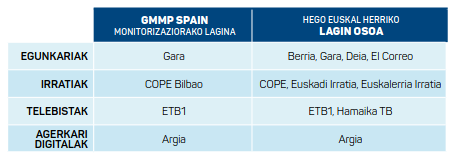
In the distribution made from the GMMP Spain group, which includes the administrative areas of the CAPV and Navarra, the following media were assigned to the UPV/EHU group: Gara, COPE Bilbao, the ETB1 website Gaur, Argia and Diario de Noticias. To make the sample wide, we took most of those taken in 2020. We left out Onda Vasca, because we already had a radio in Spanish, and to avoid the weight of public radio televisions being excessive, we decided to include in the case of EITB the Basque channels, Euskadi Irratia and ETB1. We are aware that this influences the reading of the results and the comparison of the two monitors made; however, as I said, what appears here is a fixed snapshot of a specific moment, but it can provide some data for reflection.
In total, the sample of Hego Euskal Herria was composed of 121 news items (33% in newspapers, 28% in radios, 17.5% in televisions and 21.5% in digital publications), 64 of them in Basque. As for the protagonists, 256 people are identified in the analyzed news (102 in Basque).
2.3. Technical sheet
Each researcher had to analyze and codify the 12-14 main news items of each medium. In the case of newspapers, from the cover of the printed edition, 12-14 news items that appear on the following pages. Opinions, service information (such as weather) or advertising messages were excluded from this observation. Photographic news or news interiors were taken into account for the analysis. As for the news on the website or in the digital newspaper, the same number of printed news, from the main page to the third level, had to be analyzed; as in the previous one, opinions were not coded.
In the case of radio and television, the main edition had to be recorded and all the news (political, local, international, reports on any subject, sports and meteorological information included in the news) had to be coded. Headlines, advances, analysis, as well as meteorological sections separated from the news, among others, were excluded.
Each researcher had to fill in a file for each media outlet, and for the first time the data collection has been carried out digitally, which has allowed the final results to be published in November 2025.
In each of the territorial areas of the study there was the possibility of including specific questions, in the case of the Spanish State, in order to measure the quality of the information, the specific questions that were introduced were the following:
- Does the information use inclusive language?
- Are there aspects of intersectionality observed in the representation of women (elements of vulnerability or gender discrimination)?
- Does the piece of information contain disinformation components about feminism or the struggle for gender equality?
It should be noted that the data collection sheet is agreed at the international level and is carried out on the same day in countries where very different realities coexist. Therefore, there is little opportunity to make changes to the file, and in this sense what we could call a binarist gender perspective is provided. Therefore, although in some cases it is possible to explain gender diversity, it is the data of men and women that are compared, excluding people of non-binary gender from the main statistics. However, this does not mean that they are not taken into account in deeper analyses.
3. Results
3.1. Presence of women in the news
In a first reading, the presence of women was counted, which takes into account the people who work in the media, who are mentioned or who participate in the news, both as subjects and as sources of information.
The following table shows this presence in the media and the development that has taken place since the measurement was made7.
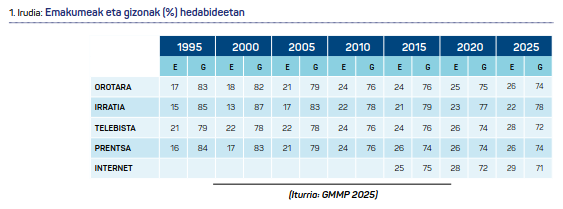
As you can see, the presence of women in the news has increased by nine points since the beginning of monitoring, 30 years ago. the upward trend to 2010 has been slower in recent years and currently the number of women does not reach a third of the people on the news, although according to the United Nations they represent 49.7% of the world population. There is a gap in all types of media, and in this sense it is worth noting that digital media have not brought changes with respect to traditional media.
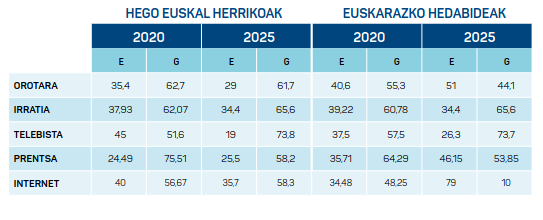
Compared to the international average, the percentage of women in the media in Hego Euskal Herria is three points higher, although it does not reach a third; it is especially low on radio, while in the press it has increased slightly. However, to understand these data in their context, two observations are made: on the one hand, the sample of radios has changed, which has allowed the difference to be so evident. On the other hand, in the written press, information is often included that is not signed or that is of interest and, therefore, the gender of the writer is not known. It should be noted that in the only Basque newspaper included in the sample, Berria, the figures of men and women are very similar and offer numbers very close to parity.
On the other hand, the presence of women in digital media is greater in the media of the Basque Country, being especially striking in the case of Argia, where eight out of ten people are women. However, it is necessary to cover in the Basque publication the congress organized by the association Naiz, in which most of the experts were women.
These television data coincide with the diagnosis made by EITB in 2025, which revealed that 46% of the people who participate in ETB1 are women; 41.5% in the case of ETB2. It should be explained that in this study, in addition to presenters, journalists, news protagonists and sources of information, the analysts participating in the tertulia, who were left out of the monitor, were also taken into account.
3.2. Genre of news authors
The fact that the journalist is a woman does not guarantee the incorporation of a gender perspective in the information, but some experts (Byerly, 2006; Geertsema-Sligh) consider that the gender of the journalist conditions the way of looking at reality. In this sense, the gender of the informant is an indicator to take into account in the efforts to combat the androcentric treatment of information. For this reason, the monitor measures the number of men and women involved in the information processes.
In the written, paper and digital media, the only way to know the gender of the informants is through their signature, sometimes it is difficult to know if the woman or the man behind a news item is. This does not happen in audiovisuals, where the informant puts his voice or body. In the case of signatures, researchers have classified journalists according to the gender assigned to the name, while in the case of radio and television, physical characteristics have been taken into account. No non-binary genres have been detected in a first approach, and in two cases people of different genres appear as authors.
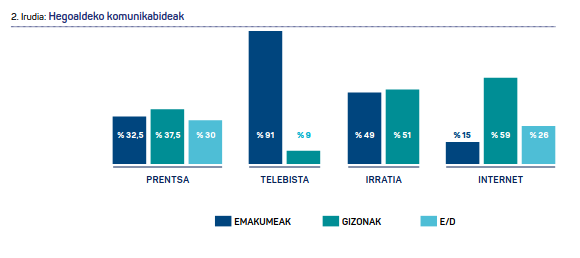
Taking into account these observations, it is clear that women are significantly higher in the two televisions measured, ETB1 and Hamaika, and in the case of radio we have a parity between presenters and editors. In paper newspapers, although women represent a third of the signatories, in the case of men the figure is not much higher. In digital media, however, the percentage of women is 15%.
Compared to the data obtained five years ago, the current photograph reflects the following graph:
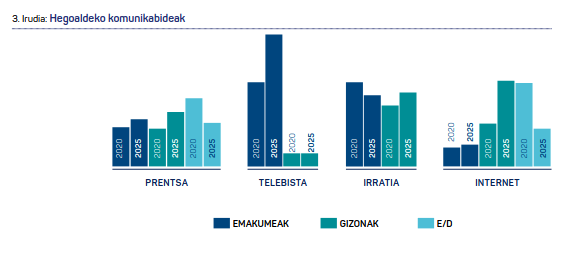
In terms of gender parity, although there are signs of optimism, another interesting reflection arises around the written media, in which the author’s gender is often not identified. In this regard, it should be noted that more and more organizations are denouncing the violence suffered by women journalists on social networks for their actions. In their testimonies, some of them explain that one of the factors behind this violence is the placement of the body, something that occurs especially in the audiovisual media8. Therefore, the unembodied authorship offers a refuge for some journalists. However, the texts not frequently signed in the analysis carried out belong to the agency and show, among other things, the precariousness of the work that is being experienced in the communication sector.
3.3. Profile of women appearing in the news
Just as the author of the news and the weight of women in it are significant indicators of gender equality or the gap, another relevant fact is to know the profile of women, that is, what is their main profession or activity.
In the following graph we can see the recognized performance of women who have appeared in the news
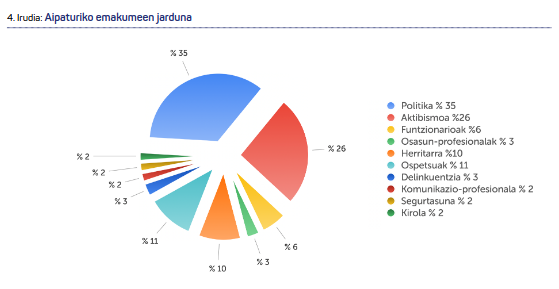
as in 2020, it is evident that the majority of women who participate in the news are of a political nature, either at the institutional level, as representatives of the citizens (35%) or as activists of a union or social agent (26%), that is, six out of ten women who participate in the pages or information sessions are political or social activists. It can be better understood compared to another data that will be seen in the next section. In fact, almost half of the women who appear in the news appear as spokespersons for a group, which shows that in trade unionism and politics in general, the obligatory nature of the quotas and the zip-lists promoted, as well as the processes of reflection that have been carried out in different groups of the third sector, have led to an increase in the voice of women in politics. Another reading of this data is the frequent presence in the media of women who already have experience in the public sphere, a fact that is especially evident in the audiovisual media, where the public exposure of women is greater.
One in ten women in the news is a celebrity and another is a citizen or unpopular activist. It should be noted that in international monitoring (Macharia, 2025) the latter appear frequently in the news, highlighting the gender gap that exists in the world; in addition, the situation has worsened in the last five years, and seven of the ten people who appear without domestic workers or professions are women.
3.4. The role of women in the news
Given the profile of women who appear in the information, and as we have already mentioned, they often appear as spokespersons for a public entity, as can be seen in the following graph
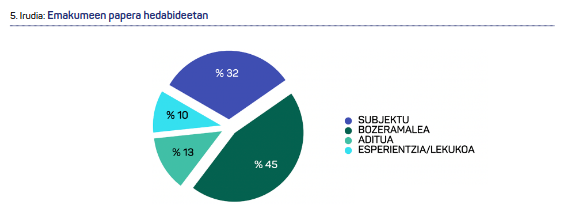
Although the monitor distinguishes between sources of information that are witnesses or that explain personal experience, in the media of Hego Euskal Herria we have grouped them under the same heading, and ten percent of the women who appear in the totality explain the experience lived and/or known in the first person.
Finally, one third of the women surveyed are the subject of the news, although this does not mean that they always appear by agency, since it is sometimes cited as a passive subject in the news, that is, as an object or recipient of the action.
In the following graph we can see the data by media:
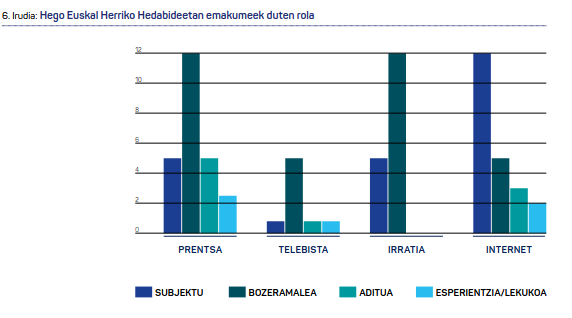
As can be seen in the graph, journalism based on spokesmanship is notorious in all media, and as has been pointed out in previous sections, in almost all media the women who participate appear as spokespersons, that is, as representatives of a group. They appear less frequently as experts or subjects, although it should be noted that the main role that appears on the websites analyzed is that of the protagonist of the news.
To complete the picture, the following table shows the presence of women on television, radio and print media, as well as the difference with the results of five years ago9.
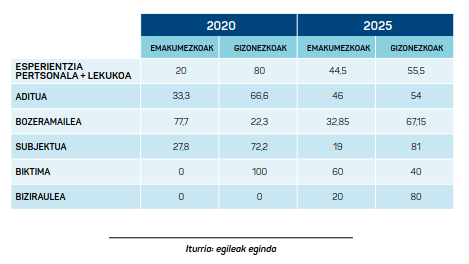
There are two characteristics to highlight in particular: on the one hand, although the number of male experts is still higher than that of women, the difference is smaller and we can almost talk about parity; it will be necessary to see if this is a trend or a one-day illusion. On the other hand, although the most common role of women is that of spokesperson, the results show that there are still more men with this function. Although these are also one-day data, it should be noted that if we take into account both data, similar data appear in the EITB study of May 2025, which indicated that 42.8% of the sources of information were women.
The total number of people who are victims or survivors of a situation of violence has been very small in the news analyzed, so we cannot explain the results beyond the percentages.
In this study, personal and witness experiences have been combined. These statements are usually made by citizens and not by representatives of a collective or by specialized voices. Contrary to what we can see in the table that collects the results at the international level, in the sample of Hego Euskal Herria these expressions are not very represented, which shows the habit of resorting to legitimate sources in the news, fleeing sensationalism.
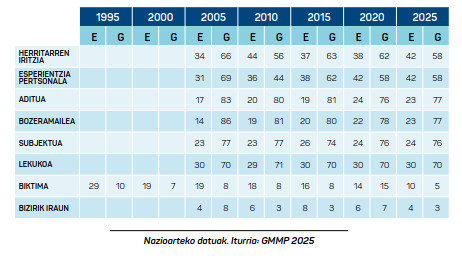
The following table shows the evolution of the role of women in the news at the international level. As you can see at first glance, three of the four people who have a voice in the news or appear with the agency are men, and there has been no noticeable progress in thirty years. The number of women approaches parity only in the case of non-expert voices, although male participation is also high.
Women who appear as victims double the number of men. However, to understand this data in its context, it should be noted that the news of violence against women in the media has been 1%. And this also shows the importance that is given to the subject in the media.
3.5. Beyond the numbers
As already mentioned in the methodology section, there was the possibility of including specific questions, to measure that the information met the quality parameters from the gender perspective, each monitor had to answer three questions.
It should be noted that inclusive language has begun to be used in information. It is true that in the Basque media it is easier than in the Castilian speaking ones, since the Basque language does not have a gender brand, but it would require a more exhaustive study, since it is not enough to differentiate the two genres to avoid the androcentric use of the language. As in the Spanish State, it is more present in news related to social issues and violence, and the percentages are similar, in one of every four news the language is taken care of.
Although intersectionality, that is, other vulnerabilities that can be added due to the status of women, have appeared, relevant numbers have not been offered, which have always appeared in some news related to social, economic and criminal issues.
The last particular question that was raised is even less: neither at the state level nor in Hego Euskal Herria have there been any clear signs of disinformation in the information that dealt with the issue of feminism or gender equality, which does not mean that this aspect should not be addressed, especially in the news related to the machista force.
4. Conclusions
As in the previous study, the presence of women in the media in Hego Euskal Herria is greater than in the international media. Moreover, at the global level, there has not been much progress in the last thirty years. As a result, we can say that we are very far from the goals set in Beijing in 1995, and there is no significant trend towards encouraging women ' s participation.
Although the radio data distorts the photo, it can be concluded that it is especially in the written media that there is a greater gap compared to other media, and that male voices predominate in the news, both as writers and protagonists or sources of information.
We can also say that the feminization of the classrooms is taking place and that more and more women are explaining the current situation. In this sense, we want to highlight that in recent years some women have taken the reins of the Basque media: Amagoia Mujika has been directing Berria since 2023; Ainhoa Jauregi took the helm of Hamaika Telebista in 2024 and in the same year Ane Urkiri took over the direction of the publication Naiz. Beyond the denominations, internal processes have been carried out in some media; as in other areas, it is difficult to influence habits and it is necessary to analyze whether the threat of the glass abyss is hidden when the communication sector is in crisis.
The situation has led this monitoring to ignore the news published on social networks, and we suspect that the current level of violence especially affects women journalists and women working in the public sphere, as evidenced by several reports, including those made by Reporters Without Borders (2025).
At the international level, women ' s testimonies are associated with personal experiences and explanations of opinion by ordinary citizens (i.e. voices with little legitimacy) and do not reach a quarter of the experts or spokespersons who appear. In Hego Euskal Herria, on the other hand, although the voices of women are less than those of men, they increasingly occupy a more prominent place in the news, especially as experts or spokespersons for a group. In this regard, as has been shown in previous studies, women who appear frequently are politicians or activists in the public sphere.
5. Bibliography
Byerly, Carolyn M. and Ross, Karen (2006): Women and Media; Malden MA. Castle Aira, Itsaso del (2024): Furious women. The female monster in the audiovisual of terror; Editorial Service of the UPV, Leioa.
EHU Campus (2025): 43% of the news collected by the Observatory of Macho Journalism romanticizes or minimizes gender violence, https://www.ehu.eus/eu/web/campusa/-/kazetaritza-matxistaren-behatokiak-jasotzen-dituen-albisteen-43k-genero-indarkeria-erromantizatzen-edo-minimizatzen-du. Campus, November 21, 2025.
Fernández Astobiza, Itxaso (2021): March 8 in the press of the Basque Country: interpretive frameworks and characteristics of the contents. https://addi.ehu.eus/handle/10810/54165
Fresneda Delgado, Iratxe (dir.) (2025): All is to be done, shoot the cinema. Donostia Kultura and Basque Film Library, San Sebastian.
Ganzabal Learreta, Maria; Meso Ayerdi, Koldo; Pérez Dasilva, Jesus; and Mendiguren Galdospín, Terese (2023). [Género edadismo eta desigualdad in the journalistic profession] [Hooking up with new digital competences]. Journal of Communication, 22 (2), 319–336, https://revistadecomunicacion.com/article/view/3198.
Garai, Estitxu; Pinedo, Naiara and Rodríguez, Zuriñe (2023): When persevering is reversing, New, January 22, 2023, https://www.berria.eus/iritzia/artikuluak/irautea-iraultzea-denean_1329154_102.html.
Geertsema-Sligh, Margareth (2025): Journalism and Gender. Global Perspectives, Routledge
Gorosarri González, María (2024). Feminist Journalism: A conceptual approach. History and Social Communication, 29(1), 133–144, https://doi.org/10.5209/hics.98681.
Gorosarri González, María (2025). Machista violence as a media storm: [Attentional multimedia proposal]. IC Journal of Information and Communication Science, 22, 153–176, https://icjournal-ojs.org/index.php/IC-Journal/article/view/890
Gutiérrez Paz, Arantza and Fernández Astobiza Itxaso (2021). Feminist Journalism in Hego Euskal Herria; Observatory, Basque Media Yearbook 2021 / Libe Mimenza Castillo and Hibai Castro Egia (ed), 2021, 161-193, https://behategia.eus/eu/urtekaria_artikulua/13374/.
Gutiérrez Paz, Arantza; Arriaga Azkarate, Tania and Fernández Astobiza, Itxaso (2023). Feminism in the Basque Podcast Universe; Basque Media Yearbook 2022-2023 / Hibai Castro Egia and Libe Mimenza Castillo (ed. ), 172-195,https://behategia.eus/eu/urtekaria/urtekaria-2022-23/.
Gutiérrez Paz, Arantza (2024): Visibility of peasant women in the Subtraia program of EITB, Behategi. Yearbook of Basque Media: 2023-2024 / Hibai Castro Egia (ed. Lit.) and Libe Mimenza Castle (ed. ), 145-168, Https://behategia.eus/eu/urtekaria_artikulua/13-emakume-nekazarien-ikusgaitasuna-eitbko-sustraia-programan/.
Gutiérrez Paz, Arantza and Fernández Astobiza Itxaso (2025). Más allá del matriarcado y la txapela, rural imaginaries in two programs of Basque public television (EITB); Miguélez Carballeira, Helena; Castelló, Enric and López López, Bernat, Nuevos imaginarios del rural: Literature, cinema and media in the Spanish context, 131-150, URV, Tarragona. https://llibres.urv.cat/index.php/purv/catalog/view/601/617/1310
(H)emen (2025) Towards a culture free of sexist violence, 2025 In the audiovisual and performing arts sectors, https://hemen.eus/wp-content/uploads/2025/12/Indarkeria-matxistarik-gabeko-Kultura-baterantz_EUSK.pdf.
Larrondo Ureta, Ainara, and García González, Carmen (2025). Periodism and community activism for gender equality: Chicas Poderosas’ Collaborative Networking Initiatives. Dígitos Journal of Digital Communication, 10, 87–104. https://doi.org/10.7203/drdcd.v0i10.284.
Macharia, Shara (2023): Building the Evidence for Feminist Advocacy and Awareness-raising; M. Gallagher & A.V. Montiel (ed. ), The Handbook of Gender, Communication, and Women’s Human Rights (pp. 361–375). John Wiley & Sons, Inc. https://doi.org/https://doi.org/10.1002/9781119800729.ch23.
Macharia, Shara (2025): Progress on Plateau. GMMP Special Edition gender equality in and through the world news media across 30 years of media monitoring, https://whomakesthenews.org/wp-content/uploads/2025/12/GMMP2025-GlobalReport.pdf.
United Nations (1995), Beijing Declaration and Platform for Action (English), https://www.un.org/womenwatch/daw/beijing/pdf
Novo-Arbona, Ainhoa; Peña-Fernández, Simon; Martínez-Odriozola, Lucía; Jiménez-Martín, Eva; and Eguskiza-Sesumaga, Leyre. (2023). Media and violence against women in the Basque Country A self-regulation case study. Feminist Media Studies, 23(7), 1421–1437. https://doi.org/10.1080/14680777.2022.2108875.
RSF 2025: 8 March: The 60th Edition of Journalists Who Have Been Talking About Gender Issues Soon Videos of Cybercrime, https://rsf-es.org/8-de-marzo-el-60-de-las-periodistas-que-cubren-temas-de-genero-son-victimas-de-ciberacoso/
Silvestre, Maria (2024): Diagnosis of the presence and participation of women and men in EITB https://www.eitbtaldea.eus/pdf.php?PuR569rIy7tHOddrODIJjA==
Suarez-Errekalde, Maialen, and Royo Prieto, Rakel. (2020). Feminist ideological sexual sphere: The role of media corporal representations. The papers. Journal of Sociology, 105(1), 143–171. https://doi.org/10.5565/rev/papers.2586
1 242. Measures to be taken by NGOs and broadcasting associations:
(A) Promote the establishment of media monitoring groups and consult with them to ensure that the needs and problems of women are adequately reflected;
(B) Train women to make better use of information technology applied to communication and the media, including at the international level;
(C) To create networks and develop information programmes for non-governmental organizations, women ' s groups and professional broadcasters to recognize the specific needs of women in the media and to facilitate greater participation of women in communication, particularly at the international level, in support of the South-South and North-North dialogue among those organizations, with a view, inter alia, to promoting women ' s human rights and equality between women and men;
(D) Encourage the media sector and media education and training institutions to develop, in appropriate languages, forms of outreach to indigenous and other ethnic groups, such as storytelling, theatre, poetry and singing, to reflect their cultures, and to use such forms of communication to disseminate information on social and development issues.
2 Presence of women in the Basque media: 2020 GMMP monitoring results in Hego Euskal Herria, https://behategia.eus/eu/urtekaria_artikulua/13661/
3 Https://www.donostiakultura.eus/eu/zinema/aktualitatea/albisteak/argitaratua-dena-egiteke-dago-zinema-tirokatu
4 Https://www.ehu.eus/es/web/gureiker/emakom
5 Https://periodismomachista.com/eu/
6 Https://www.ehu.eus/eu/web/campusa/-/kazetaritza-matxistaren-behatokiak-jasotzen-dituen-albisteen-43k-genero-indarkeria-erromantizatzen-edo-minimizatzen-du.
7 The data for 2020 do not correspond to those published in 2021, but then we warned that at the time of writing this article, we only had an advance of the results. The ones that appear here are definitive data.
8 Although they were opinion leaders, the article written on January 22, 2023 by some of the women who participated in the EITB gatherings is very significant: https://www.berria.eus/iritzia/artikuluak/irautea-iraultzea-denean_1329154_102.html
9 The following table does not include data from Internet media whose results were combined with those obtained on Twitter in the 2020 study