

In the context of postmodern society, characterized by immediacy, excessive information and the influence of artificial intelligence, the media have lost a monopoly on the creation and dissemination of content, remaining in part in the hands of social networks. Journalism has responded with more superficial and easy to consume content. In the new paradigm, however, there are media that face new challenges with more inclusive narratives, in more creative formats, and above all, with greater social commitment.
In short, they propose other forms of communication: local, alternative, community or with a broad social base. In this article, together with the analysis of the formulas that this practice currently offers in various media, the interviews carried out offer an approach to the nature of the media in this modality. The contributions of the researcher and journalist Txema Ramírez de La Piscina are the compass.
“This new model of communication is more necessary than ever. Disinformation has always existed. But now, democracy itself is corrupting. Even more so with the unethical use of Generative Artificial Intelligence” (Ramírez de la Piscina, 2025).
We live in an age of excessive information, the loss of credibility of traditional media, the detection of signs of lack of professional control in some digital news media and the growing precariousness of the labor force in the communication sector. All this is framed in the context of a global crisis, exacerbated by the recent health crisis, which has posed serious challenges for journalism, governments, political parties and the general public (Goikoetxea and Peñafiel, 2023). In this context, there is an excess of information; people do not have time to read everything they would like to read, much less to process, analyze or criticize information (Campos, 2010). This information overload is also called “infoxication” (Barranquero-Carretero and Sáez, 2021).
According to the report by the University of Oxford and the Reuters Institute (Digital News Report, 2025), almost 70% of Spaniards do not trust most of the news that is published and about 40% avoid actively consuming the news. This report indicates that the percentage is associated with the perception of lack of credibility, bias in the information and saturation of the contents. According to data collected by the University of Oxford ten years earlier, only 34% of Spaniards trust the maximum amount of news published in the media, and the data of those who have lost confidence has increased significantly. This puts Spain far from Finland, where 68% of the population trusts the media1.
The Digital News Report shows that local and regional newspapers generate the most confidence, with about 51% of respondents agreeing with the statement.
1. Definition and characteristics in our environment
If we go to the behaviors of the Basque Country, we will find numerous examples of participatory journalism2. In fact, they are local media, with a long tradition, of community, alternative or broad-based social media.
Daniel Innerarity said before the explosion of Artificial Intelligence (2017) that it is time to criticize the traditional media model (centralized and hierarchical) and rethink how information and communication processes are organized in complex times; to think about alternatives that are democratic and reflective. Ramírez de la Piscina (2025) agrees that this Alternative Communicative Model is more necessary than ever: “Disinformation has always existed. But now democracy itself is being corrupted, even more so with the unethical use of Generative Artificial Intelligence: it has had a significant influence in several elections; many people do not see the mainstream media because they are saddened by bad news or think that these media are manipulated.” According to experts, we are facing a serious problem, because these gaps fill those false information that spreads at full speed. Media literacy is more necessary than ever, the survival of Democracy is at stake.
In order to explore the behaviours of this type of communication experiences and in a context in which globalization seems to be an indisputable principle, Nieman Lab3 (2019) reports on its website an interesting research: “Do you want to reduce political polarization? Protect your local newspaper.” In it, the diversity of thoughts and stories of popular magazines is emphasized. Therefore, in this sense, the words that Nieman Lab wrote seem to remain valid. Ramírez de la Piscina also points out that political and media polarization is very evident if we look at the Spanish and American media; in the Basque Country the political and communicative reality is different: “In our country, large media groups also have a significant influence, but thanks to these local and social media, the media agenda is broader, the composition of public opinion is focused in a different way.”
Several authors claim that another model of communication based on democratic, critical and participatory values is possible without the need to reproduce the logic of the big media4. In this sense, Ramírez de la Piscina emphasizes the expansion of authoritarian models and communicative systems that favor social control: “A high-quality public media outlet like the BBC is under tremendous pressure. I’m not good on that side.” He also points out that it is necessary to carry out public policies that allow the creation of community media, as well as the approval of rules that penalize the illicit influence of the giant media: “Media ownership limits the content of the product. A movement that promotes an alternative social model in the agenda setting of groups such as Vocento or Prisa will never prevail. We know that too well.”
On-the-spot communication is a first-hand journalism that aims not only to exchange information, but also to facilitate citizen participation and social cohesion. Community or social initiative communication is understood as a participatory and local communication process, focused on strengthening the identity, cohesion and development of a community, always with the aim of promoting social participation, community education and social transformation from the base. We also call alternative communication those communicative practices that seek to offer a different voice to traditional media, questioning power structures and hegemonic discourses. Promoting diversity, social inclusion and transformation, making marginalized or silenced groups visible.
Today in the Basque Country we have a very wide network, which is the network of local media. Its main function is to work on close information, usually outside the main political debates. Ramírez de la Piscina represents it transparently, “we have reasons to be proud. Because it’s very broad—in every sense—and diverse.” He adds that, in our country too, large media groups have a significant influence, but thanks to these local and social initiative media, the media agenda is broader, focusing differently on the formation of public opinion.
“Let us not confuse things: alternative communication is a movement that wants to build another economic and communicative model instead of the capitalist model that prevails in the world, supportive, open and promoted from the bottom up” (Ramírez de la Piscina, 2025).
Most of them are also characterized by educommunication, understood as an interdisciplinary field, using the media as a pedagogical tool, combining education and communication. One of them has an interest in its objective: to develop critical and creative skills in the humanos. To this end, it seeks more dynamic and participatory learning, and also addresses the need for citizen participation and social transformation. It also involves the promotion of critical thinking (Vendrell-Morancho, Valero Moya, 2025). From an academic and communicative perspective, critical thinking requires a process of reflection that includes the identification of assumptions, the evaluation of arguments and the consideration of different perspectives (Goikoetxea, 2025). The ability to question and confront preconceived ideas is an essential component of critical thinking. Building this capacity not only empowers individuals to make more informed decisions, but also contributes to building more just and democratic societies where dialogue and reflection are valued. In an ever-changing world, critical thinking is a beacon that directs people to a deeper and more detailed understanding of reality. Ramírez de la Piscina says that we have to recover Immanuel Kant and the Enlightenment, Sapere aude! “Dare to know”: “Equip your thinking with your own reasons. But, of course, for this you must first be able to discern between truth and lies.”
“If you were to ask people on the street now if they were critical of the media, I’m sure a lot of people would say yes, of course. “I don’t believe anything,” they say. But, if you delve into it, you will realize that your points of view on fat issues are those that have been shed from these main media. Then? Then? There are major shortcomings. And we are not aware of it” (Ramírez de la Piscina, 2025).
In this context, the professor of the UPV/EHU agrees that transgression, reflection and action could be key words: “Communicative transgression is an artifact that must be managed very well. In fact, you can design a very perfect, aesthetically brilliant, vindictive and powerful action, but the main media will turn it around, stay with the elements of the cover and try to use it against this movement. Not saying it is not enough. The alternative should also be considered.”
In this sense, the media that have appropriated our SOA are: Aiaraldea and Antxeta Irratia5, the Hala Bedi project and the magazine Pikara, awarded by the Basque media network TOKIKOM.
“Trump and his supporters use the term AltRight. That is, the Right Alternative. They also claim “alternative” in order to reach wider audiences. The term "alternative day" is heavily prostituted. Totally devalued. We need to reflect seriously6” (Ramírez de la Piscina, 2025).
2. Aiaraldea
on April 17, 2010, Aiaraldea was created with the aim of promoting the Basque language in communication, thanks to the enthusiasm and work of the volunteers. The members of Aiaraldea (2025) have explained to us that they have moved towards a conscious transition towards professionalization, incorporating stable staff to channel the strength of volunteering, carrying out strategic reflection and strengthening professionalism to consolidate referentiality. Today, in addition to journalistic work, the audiovisual presence is structural, favoring the use of social networks and the diversification of formats. It also provides a clear normative positioning on the use of artificial intelligence and critical thinking: AA is understood as an auxiliary tool but not to replace the journalist.
Aiaraldea’s objective is to promote the use of the Basque language through an informative follow-up of the reality of the region. The coordinators emphasize that they have other axes, such as feminism, interculturality, food sovereignty and a very important transversal component, such as being a community media outlet: “Aiaraldea’s activity is not limited to the production of neutral information, but understands itself as a communication of social responsibility in which the choices of content (what to tell, how to tell, what image to use) are organized in coherence with the transformative objectives of the project.”
The community character derived from its relationship with the Aiaraldea Cooperative Society is also a determining element: the medium is not a closed unit, but a project that is built on a permanent relationship with the community, in which the demands and citizen participation (contributions, acting as a source, protagonism) are part of the functioning.“To say that Ayala is an alternative is too much, given her dependence on subsidies, the whole criticality is limited, among other things (advertising is also conditioned), by her dependence on subsidies and to some extent on advertising, which problematizes the label of “alternative”.”
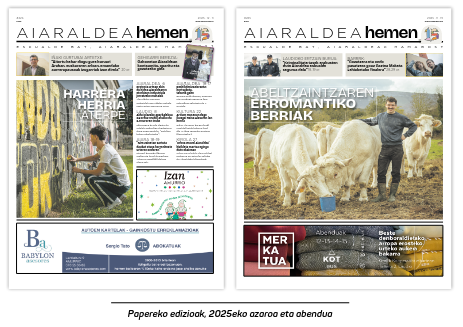
If the referentiality has been built, according to Aiaraldea, “this is linked to the fact that in the main socio-economic conflicts in the region (Tubacex, Glavista, Maderas de Llodio) a coherent local look has been maintained, informed from the core of the conflict”. In editorial, therefore, the agenda is based on a hybrid logic that “responds to current events, but the critical axes of the project (feminism, interculturality, community approach) are never ignored”.
Aiaraldea places its contribution to quality journalism in the advantages of small-scale journalism: proximity makes “what has happened” more accessible, increasing the possibility of verifying and nuanced information. This perspective leads to greater resilience in the face of disinformation (fake news), since the actors and testimonies present in the community itself allow a faster verification work. Critical thinking, on the other hand, is considered a structural condition of the production of information; the transformative objectives of Aiaraldea encourage the integration of this criticism in the contents and possibilities of representation. The coordinators are clear: “Criticism has given reference to the media and enemies, of course. The receiver, I think, knows that when Aiaraldea informs that it is focused on the local and will offer that point of view.”
3. Antxeta
The Antxeta project is defined as a local community communication initiative. in 2001, the waves of the Bajo Bidasoa region were born, with the intention of shaking them freely and in Basque. It is a radio that has been stabilized, reticulated and expanded year after year. Initially conceived as an FM radio, it has now become a transmedia communicative project with multiplatform logic (including the web, podcasts and video podcasts). Antxeta places its roots in the social and transformative economy and is also a member of the BDSKoop Transformation Factory. This is how the coordinator Aitziber Zapirain (2025) explains it: “The radio project is not only a broadcasting tool, it also structures initiatives to promote a more inclusive society (historical memory, social and solidarity economy, regional integration, gender equality), and Antxeta’s current identity is Basque and feminist.” Therefore, there is an explicit attempt to incorporate the foundational framework of values (inclusion, anti-racism, feminism, community perspective) as a line throughout programming, extending the ethical-discursive coherence to the daily dynamics of production. Regarding agenda-setting and editorial decision, to differentiate it from the mainstream and to act coherently from the value base, he highly appreciates the importance of collective deliberation.
The quality approach of the project is also clearly formulated by prioritizing quality over quantity. Antxeta sees the way clear in terms of source management and disinformation, stating that proximity and community network, among other things, narrow the space for the dissemination of fake news content: “When information comes in (especially from institutions), there is an attitude of direct contrast and inertia of contrast with local associations/actors, looking for regional experts for each topic and contextualizing the information, differentiating it from the noise that can be spread quickly.”
They believe that proximity provides a strategic advantage: “Because sources and audiences are close, the ability to identify direct feedback and red lines sharpens professional performance, and constant self-monitoring in alarm mode strengthens quality control.” For Zapirain, “alternativity” is derived from this, with social and labor coherence: “This allows us to dedicate an hour to a topic that they would give in 30 seconds in any other conventional medium, if we think it is interesting, if we think that our community wants or needs to know about it. All our content includes popular movement, neighborhood associations, local organizations, professionals specialized in the specific issues that make up our community.”
In addition, Zapirain is clear that the critical perspective is also one of the main axes of the communication project, that is, they seek in their daily activity to satisfy the needs that make up the community, and they want that community to be critical of society, but also of the activity of the medium, to feel free: “I think we are a tool to keep this critical vision alive. We don’t believe that journalism is objective; it doesn’t exist. So we try to offer a critical perspective in the treatment of our information; there is no absolute truth. That is why we often leave questions in the air and when necessary, we contradict opinions: even if you are the mayor, your opinion will also contradict another.”


Today, although the organization of work and the relationship with the public are transformed by digitalization, there is a firm will to continue articulating closeness through mechanisms of participation and collaboration. Regarding artificial intelligence, the positioning is pragmatic and limited: new technologies are not seen as a problem, but legitimate uses are focused on transcriptions and subtitling, and these tools are not allowed to replace journalistic production: “Our first strategy from the beginning has been not to see new technologies as a problem, but to know how to adapt them and what juice we can extract from each of them for small, community and Basque media.”
4. Hala Bedi
Hala Bedi Irratia is based on a communication oriented to social change, both by content and by organizational structures. It is characterized by self-management, assembly functioning, interculturality and appreciation of diversity as values, close and participatory communication. It is the second oldest free radio station in the Basque Country and is part of the Arrosa association. As Jon Hidalgo points out, two complementary threads must be mentioned: “The first direction is to give voice to the voiceless, that is, to make visible collectives and realities that do not appear in the main and commercial media. The second direction is to free oneself from pressure networks: circumvent the constraints imposed by dependence on advertising, editorial lines of economic interests or government/business interests."
After a deep reflection, it has gone from being a radio that satisfied the desires of the moment to being a solid and developed communication project, with almost 50 radio programs. The formats have also been disseminated: news and written reports, videos/photographs for the coverage of the mobilizations and audiovisual supports for the groups7. The thematic agenda of the project does not depend on the event, but also has historical and social lines that are deepened through the report.It is also part of a broader ecosystem of alternative communication, consolidated through content circulation and collaboration. Hidalgo recognizes the existence of “noise” and algorithms in the platform environment and the difficulty of counterweight, which is why he insists that collaboration (inside and outside the Arrosa Network) is fundamental. In addition, it proposes as a responsibility to be the only radio in Basque in Álava, clearly formulating the strategic direction, offering content in audio, text, video and networks.They are also beginning to use AI as a time-saving tool, but not as a substitute for the core of journalistic work.
Editorial freedom is formulated as a structural condition, not as a mere subjective will of the journalist. The collective has no control intention: “We don’t control, we don’t limit what people do. Many social actors use radio space for self-representation and the construction of their own speeches.” Examples of this are environmental, internationalist, feminist movements, groups linked to the occupation, as well as those around “Zero Waste”.

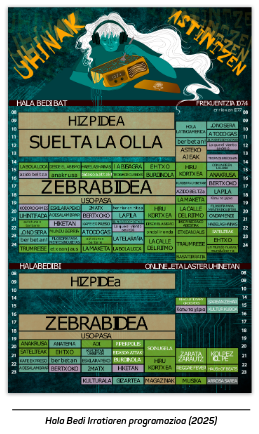
They work on the current situation, but “without swallowing”; it explicitly states that they have no capacity (or purpose). Instead, it’s a priority to address issues that don’t often appear in other media, says Hidalgo
“What happens in collectives and movements, that doesn’t fit into the main agenda. And along with this, give space to analysis and context: you can also address issues that appear in other media, but from “our” perspective, such as security speeches, problematizations related to migrants and issues that arise in the name of public order”. Here, in practice, there is the question of framing or the interpretative framework: take the same subject, but ask other questions and establish a new definition of the public interest.He adds that it is legitimate to work on a topic even if there is not much news a week: “We have been working on the housing issue since the beginning and it needs to be given importance. The logic of the project is not only to follow the facts; there is thematic continuity and a willingness to place social problems in the medium to long term.” He says that censorship or self-censorship appears in many media (due to the pressures of companies, the interests of their bosses or the logic that “will bring me problems” within self-censorship) and that for this reason they are grouped as editorial groups: "Come together and decide how to approach the issue from the perspective of the citizens and oriented to the benefit of the left/revolutionary movements. In other words, independence is not an abstract principle: it becomes an organising practice for deciding the agenda and the treatment”.
Thus, Hala bedi Irratia, questioned about the function of criticality, looks at the deregulation and the democratic counter-revolution: “You can’t trust everything that the mainstream media provides because political interests (sometimes explicit, sometimes subtle) are embedded in the decisions; escaping from that is the task of the alternative media.” He understands criticism as a “struggle”: “Denounce, complain, and dis-normalize practices that are being normalized as common sense.” He refers to the rise of fascism, racism and machismo in the global context and argues that normalization processes pose a democratic risk: if it is not pointed out, people consider it natural. Therefore, criticality is not an editorial style: “It is a mechanism to keep democratic coexistence and public debate alive,” he says.
“Criticism is not just an editorial style, it is a mechanism to keep democratic coexistence and public debate alive” (Jon Hidalgo, 2025).
5. Pikara Magazine
Pikara Magazine is a journal that disseminates feminist theory and practice, incorporating a gender perspective in the perception of journalistic work in the media. It was founded in 2010 by Basque journalists Itziar Abad, June Fernández Casete, Lucía Martínez Odriozola and Maite Asensio. The members of the editorial and publishing collective of Pikara Magazine identify with different trends: feminism of equality, transfeminism, lesbofeminism, ecofeminism, Andalusian feminism and gypsy feminism. That’s why they don’t have a closed editorial line that tells stories and news that could be of interest to anyone, visualizing androcentrism and sexist stereotypes based on equality and diversity. One of the coordinators is the journalist María Ángeles Fernández “Our goal is to work and show a feminist perspective that does not appear in the media in a transversal way. We ask other questions, we make an analysis of social reality, telling the world better, including all people, in order to make a real social chronicle.” In this sense, questioned about his contributions to quality journalism, Fernández focuses on the questions: “The questions that journalism offers are the key. The key is to question the concept of normality and the “average person” and see how it affects society. Understanding the concept of peace, for example, beyond the universal subject”.
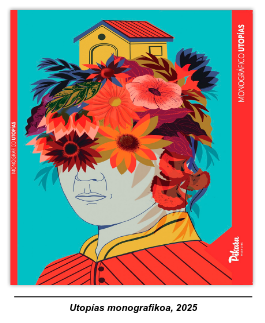
Although Pikara Magazine was born from the need to tell stories that were not published in the hegemonic media, today, through internal criticism and reflection, they also address both anti-capitalism and anti-racist discourses: “We have a lot of eyes, that’s how we work. We believe in diversity, both in terms of themes and in terms of women. Migrant women are sources of information, but also writers. It is precisely because this is the root or structure of the medium, the horizontal and the one that constructs the bottom-up agenda: “Our mission is to serve, not precarize, pay quickly, respond, avoid competitiveness and bet on collaboration, share sources and knowledge, be on the street, generate content from below, bet on transparency.”
As for the issues, they try to give a feminist perspective applied to the current agenda, but they always work on it, it is transversal: “Our agenda is with social movements. A wide and varied cooperation network is very enriching and necessary. That’s what our society is all about.” The coordinator of the working group also recognizes that the absence of the burden of current affairs helps to move away from fake news: “We are fleeing from the immediate. We do more analysis, reflective journalism, very analytical; our journalism is more paused.” The constant questioning of reality is fundamental in the project, since the media not only educate but also offer an opportunity for criticism: “We encourage critical thinking and constructive debate that drives dialogue and growth.”
6. Epilogue
The study shows that broad-based, alternative and local media are of extraordinary importance in the face of social crises, in a changing scenario saturated by the floods of fake news and artificial intelligence. Proximity and its own agenda, the freedom to choose the interpretative framework and the participatory network are the keys. All the managers interviewed stressed the importance of this specific seal, highlighting the strategic and quality bet on quantity. They unanimously emphasize that this Alternative Communicative Model is more necessary than ever.
It also highlights that we are facing a bubble of disinformation; this threatens democracy by sacrificing professional quality, information quality, ethics and deontology. Faced with this trend, the interviewed experts consider it essential to act as a space for criticism, strengthening, among other things, initiatives to promote participation, inclusion and a more inclusive society. All agree on the responsibility of educating these media, always bearing in mind the criticality applied both internally and externally.
It is in this context that alternative and community media have a place. As indicated in the portal, Nieman Lab seems to continue to insist: Do you want to reduce political polarization? Protect your local environment.
7. Bibliography
Aiaraldea (2025). Interview conducted online.
Barranquero, A. & Sáez, Ch. (2021). Communication from below. History, feelings and practices of alternative communication in Spain. Gedis. Gedis.
Campos, F. (2010). Media Change Management (managing media change transition) In: Campos, F. (Coord. ). The media change. Zamora: Social Communication Ediciones y publicaciones.
Fernández, María Angeles (2026). Interview conducted online.
Goikoetxea, U. (2025) The need for critical thinking in the algorithmic era in Intersections of the digital: culture, philosophy and communication / coord. by Gabriel A. Corral Velázquez, Rosario Barba González, 2025, ISBN 978-84-1319-653-4, pp. 40-55
Goikoetxea-Bilbao, U., Peñafiel-Saiz, C. (2023). “Disinformation and the need for an uncontaminated journalism” in Disinformation and fact-checking in contemporary society (Daniel Catalán coord.) Dykinson E-BOOK. ISBN: 978-84-1170-710-7
Hidalgo, Jon (2025). Interview conducted online.
Innerarity, D. (2017). Medios que miden, The Basque Newspaper. https://www.danielinnerarity.es/opinion-preblog-2010-2016/medios-que-medien/?utm_source=chatgpt.com
Ramírez de la Piscina, Txema (2025). Interview conducted online.
Vendrell-Morancho, Mireia; Valero Moya, Aída (2025). [Cartografía del pensamiento crítico: main contributions to repent education]. Educ Pesqui 51 Https://doi.org/10.1590/S1678-4634202551278119es
Zapirain, Aitziber (2025). Interview conducted online.
1 Below are Brazil (62%), Germany (60%), Denmark (57%), United Kingdom (51%), Ireland (48%), Japan (46%), Australia (39%), France (38%) and Italy (35%). Of the 12 countries studied, only the United States (32%) is below Spain (Newman, N., Levy, D. and Nielsen, R., 2015).
2 Berria, Gara, Goiena, zuzeu.com, EITB blog (the latter is neither community nor alternative. However, it is interesting for its contribution to the normalization of the use of the Basque language in recent years).
3 Www.niemanlab.org/2019/02/want-to-reduce-political-polarization-save-your-local-newspaper/
4 We understand these media, in the field of popular communication, as a heart or space for auzolan, not as resistance, nor – in its relationship with massiveness – as degradation: they are far from commercial purposes, and their origin and purpose are the participation of all citizens and the treatment of information and social issues that escape the hegemonic perspective: neighbors, indigenous people, environmentalists and feminists. Most of them are related to the world of the Basque language and are published in Basque.
5 The prize for the best content went to Aiaraldea, Jesús García Ferreiro: when the pain becomes unbearable for the report. The theme of suicide is the essence of this report. The award for the best audiovisual has gone to Antxeta Irratia. Voices against Lodiphobia by series of interviews.
6 Four or five decades ago this term was associated with the underground movement, with counterculture, etc.; that is, it was used by those who wanted to overthrow the capitalist model. Today, the term is often used by those who defend the crudest version of the capitalist system. In fact, the official model for AltRight is the “progree” model, the woke movement they use with disdain, LGTBIQ+ policies, etc. They"re a real scam. They say they are against the elites, being themselves part of the economic elite. So let’s not confuse things: alternative communication is a movement that wants to build another economic and communicative model instead of the dominant capitalist model in the world, supportive, open and promoted from the bottom up.
7 cites as a concrete example a line of reports on the memory and transmission of March 3, with attention to intergenerational transmission and social memory.