


Elhuyar has been immersed for a year and a half in a process of reflection in search of ways to socialize science and technology more effectively. It has four pillars to work on in the future: Implementation of a CMS, creation of the Observatory of Scientific Communication in Basque to guarantee quality, development of resources to collect the opinion of citizens and experimentation of new ways of communicating science that lead to a real social transformation.
CMS and Living Archive
Until now, Elhuyar had several websites that disseminated science and technology from the perspective of different projects: Website of the magazine Elhuyar (aldizkaria.elhuyar.eus), website of the television program Teknopolis produced for EITB (teknopolis.elhuyar.eus) and zientzia.eus. The magazine’s website responded to the current situation in written format, the Teknopolis website disseminated it through audiovisual media and zientzia.eus collected the content published by Elhuyar in all its socialization projects. It was a repository of more than 25,000 contents in Basque of science and technology.
Each one fulfilled his function, and that is how Elhuyar has fed them for many years. Always knowing that with this system, to a certain extent, websites competed against each other in different aspects: mainly in user traffic and SEO positioning, but it could create confusion in users and weaken brand coherence. In addition, it dispersed analytics and made it difficult to make decisions.
This led us to discuss the possibility of a conciliation process, and the decision was made thanks to the fact that the Basque Government’s Hedabideak call allowed the presentation of communication projects. This is how Elhuyar Zientzia was born, which has been reflected in the website zientzia.eus.
In this unification, we decided to take another step: implement a content management system (CMS) with the support of the company Code Syntax. With CMS, we can more efficiently manage the written content, images, videos, audios, surveys and other digital resources that we have stored in the database. We now have a more complete layout system, in which the result of the layout is visualized in real time and different design components can be incorporated according to the needs of the content. In fact, it allows you to layout content of all formats and make multimedia content with a single tab model. This layout can be taken to the paper magazine if desired.
In addition, the management system also makes the work easier for the editor: it gives him great flexibility when organizing the contents of the medium on the cover to give strength to the content. It makes the whole team more autonomous without having to change the programming code. On the other hand, we have also started to create automated content. We have automated the ephemeris section, but we will explore the possibility of creating more content.
It was decided to complete the CMS with a new website design. On the one hand, to adapt to current design trends and, on the other, to organize the published content in a more effective way to respond to the current situation. We asked the Navarrese agency Errea to design the website of the media. Their support was essential to imagine a more dynamic and contrasting medium and to overcome the limiting visions that we can have as a specialized scientific medium.
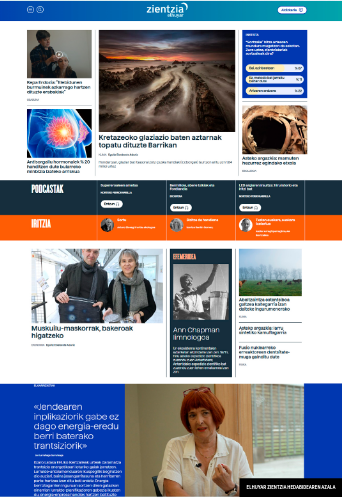
The CMS and the new design have been essential components to strengthen the media character of zientzia.eus and to take real advantage of the convergence process of websites. In addition to being a more appropriate tool to respond to the current situation, from the beginning the very nature of the meeting point of zientzia.eus has been reinforced: we now have elements that allow us to bring the historical content to the surface whenever we want it, making the historical archive an additional resource to respond to the current situation. As a result, what until now was only a repository has become a living archive.
At this moment, we can recall at any moment the scientific news that was significant at the time. Or, to respond to any ephemeris, we can bring visions collected in the past. It also offers the possibility of sharing the contents that have been worked on in different projects around the same theme, combining audiovisual, audio, text and illustrations.
In the new design, new elements have been incorporated that respond to the multiple habits of digital content consumption: vertical videos, short formats of easy consumption, opinion columns to guarantee plural voices, ephemeris to help build collective memory, weekly photography to influence through visual impact, monographic blocks to deepen and contextualize a certain topic
We are also making the leap in analytics: We are enriching the BEHA panels created by Hekimen and the Basque Media Observatory to adapt them to our needs and be more functional in the knowledge of users. To better segment the audience, know their interests and trends, perform a weekly analysis of web consumption, identify the topics and supports that readers like and assess the need to adapt our performance. It aims to become a strategic tool at the service of the objectives of the media.
What do you think of science?
The convergence process had to respond inevitably to another challenge: to incorporate a platform on the web to collect the opinion of society. In fact, 40 years of experience in the socialization of science and technology have shown us that science has a great capacity for social transformation, as long as it is generated in dialogue with citizens. Otherwise, if you don’t listen to the opinion of the citizens, you become lame and the distance between science and citizenship increases.
Science and technology have been nourished by this distance on many occasions. It has been empowered by the exclusivity of knowledge. But the democratization of science and technology requires that every citizen be guaranteed the opportunity to express his or her opinion about them in a natural way. What"s more, to promote it.
Elhuyar’s joint communicative project uses two tools, among others, to democratize knowledge: to give the word to the scientists of Km 0 to give up a globalized and homogeneous discourse on science and technology and also to develop a Basque vision of its own. And to ask the opinion of the citizens again and again.
Thus, every week we ask the readers a question that fits with the contents worked. This allows us to know the perceptions, opinions and concerns that citizens have. What’s more, over time, it will provide us with a very interesting historical archive to see how the opinion on each topic changes over time.
Observatory of Scientific Communication in Euskera
The third leg of the union aims to put the emphasis on quality. In order to be critical of the dissemination we make, we have created the Observatory of Scientific Communication in Basque. We have analyzed the news of science and technology published in the digital press of the Basque Country to identify our strengths and weaknesses.
We have looked at variables such as equality, territoriality, what areas of science are exposed, whether the human and social sciences are looked at and whether all the Sustainable Development Goals are looked at. The results clearly show where the potential for improvement lies:
As far as territoriality is concerned, there are significant differences between them. In the Spanish-language press, Donald Trump, Elon Musk and Pedro Sánchez are the most cited in the news about science and technology. The three, referents and men from outside the Basque Country. In the Basque press, however, the main references are the local ones: Ana Galarraga, Juan Ignacio Pérez and Joxerramon Bengoetxea.
In terms of equality, major challenges remain in the media as a whole. In the Spanish press, 69% are men and only 31% are women. 63% men and 37% women in the French language. The Basques are much closer to equality: 56% are men and 44% are women. In Elhuyar Zientzia, 47% men and 53% women. The data show that egalitarian editorial policies are essential in journalism, since otherwise a partial and distorted vision of science and technology is disseminated in society.
As for the topics, the general media mainly collects news related to technology. To a lesser extent, those related to the environment, life, human and social sciences and basic sciences are presented. The data show that there are issues with very little media visibility: only 4% of the news related to science is related to basic sciences –physics, geology, mathematics...–, although their contribution to the development of knowledge and technology is very high.
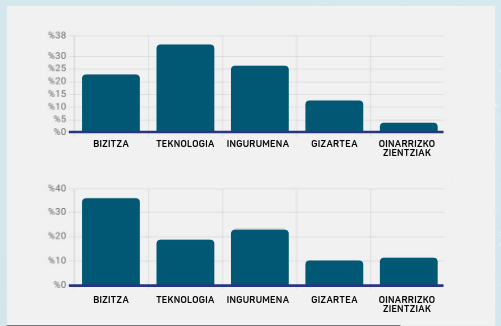
It should be noted that basic sciences are the intellectual basis of all innovation, although their value is seen on a longer time scale. Therefore, it is essential to make these sciences visible to society. If basic sciences are excluded, society is likely to receive a highly productive image of science, without understanding the method, doubt and construction of knowledge so characteristic of science. This makes it difficult to understand the importance and nature of scientific evidence and can also create a socially demanding attitude towards science.
With regard to the Sustainable Development Goals, it has been analysed whether the news on science and technology is really related to them, and it is observed that the media mainly disseminate news related to three objectives: innovation, infrastructure and industry (9. SDG), related to the climate crisis (13. SDG) and health-related (3. SDG). They remain silent on poverty (1. SDG), hunger (2. SDG), clean water and sanitation (6. SDG) and gender equality (5. SDG) related. The data show that most of the news is framed within the framework of the digital and energy transition, and that the media underestimates the contribution that science and technology can make to social justice.
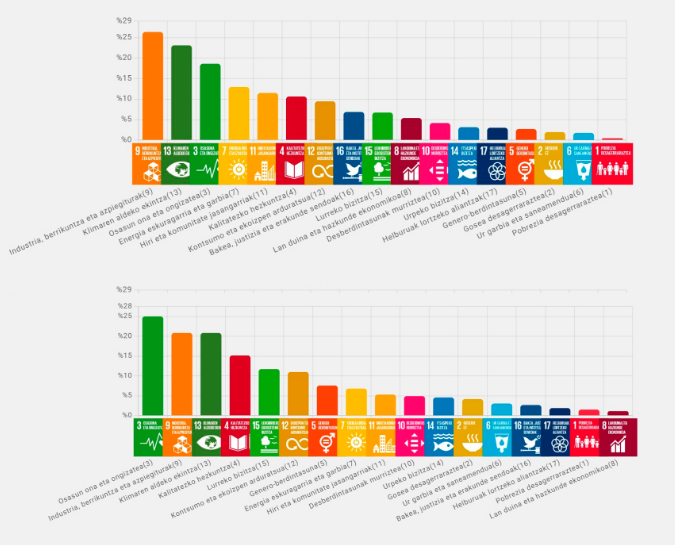
Elhuyar, through the Observatory of Scientific Communication in Basque, aims to lay the foundations for quality scientific journalism. It opens up a series of strategic questions for the Basque press: does the scientific and social relevance of the topics dictate in the Basque press, or does the global political-economic agenda and media personalities attract all the attention? What references does the Basque press create around science and technology? What role does science and technology play in society? These are strategic editorial decisions for the sector, taking into account the social commitment of the media.
Innovative ways to socialize science:
Elhuyar’s goal is to transform society, so the ultimate goal of this reflection has been to find more effective ways to truly transform society by socializing the knowledge of science and technology. We have been experimenting with innovative means of communication. The strengthening of the character of the media will undoubtedly allow us to socialize science more effectively, and this is – and will be – our main activity. But experience has shown us that, in order to truly transform society, being a mere means of communication is not enough. Different experiences need to be created for the people.
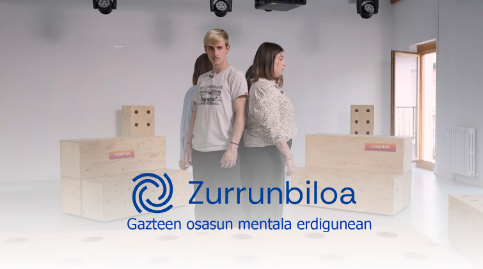
In this way, the latest projects are based on social concerns. For example, the project on mental health in young people: Zurrunbiloa.eus. In addition, more and more, we are enriching the projects with people from other disciplines. As a starting point, we made a reflection on the subject together with thirteen experts: pharmacists, psychologists, psychiatrists, teachers, sexologists, neuroscientists, sports coaches, anthropologists and experts in digital health. But in addition to experts, we are increasingly working with local organizations and other actors.
For example, in the Zurrunbiloa (Swirl) itself, we have put young people in dialogue with young people. They have told their experiences live, from young to young, sharing pains, anger and illusions without taboos. we have collected the opinions of 536 young people to know their opinion on the subject.
On the other hand, our projects are increasingly promoting citizen participation, with the collaboration of Elhuyar’s colleagues who dynamize participatory processes. We talk to people and experts. We are convinced that if science is going to transform society, it will be this way.