


Following the annual tradition, in this article we will look at the international community to have a global vision of what is happening in the media. Taking into account the main challenges facing journalism and the media today, we will try to analyze the main international trends. How have the main challenges been addressed in 2025? What is the expected evolution in the future? To answer these questions, we will focus on the analysis and forecasts of trends in communication in the following lines.
In the world of the media there are many challenges, because it is not a sector in favor of the wind, but quite the opposite. In analyzing international trends, I have selected some of the main challenges in order to offer a global vision: the human rights of journalists, freedom of the press, disinformation and confidence in journalism, economic viability, disruption of artificial intelligence, new avenues of journalism and gender gap. These challenges are not isolated, but interrelated.
Human rights and freedom of the press
From the point of view of the human rights of journalists and the freedom of the press, the year 2025 can be considered black. Among other things, because local journalists have been targeted in the Israeli genocide in Gaza. All reports indicate that the highest number of murders of journalists worldwide occurred in Gaza in 2025. According to the annual report of Journalists Without Borders (RSF)1, more than 40% of the world"s journalists killed in 2025 have been killed in Gaza by the Israeli army. According to this report, 67 journalists have been killed in the world, 503 have been injured, 20 have been kidnapped and 135 are missing.
According to the report of the Federation of International Journalists (IFJ)2, 111 journalists were killed in 2025 (124 in 2024). The majority of the killings (51, 46 per cent) took place in Gaza. In addition, according to the list registered by the IFJ, there are 533 journalists in prison. The Committee to Protect Journalists (CPJ)3 monitors the situation of journalists in Gaza, and data collected indicates that, since 7 October 2023, Israel has killed 252 Palestinian journalists in Gaza, wounded 173 and jailed 94.
after the ceasefire agreed in October 2025, although the murders of journalists in Gaza seem to have stopped, they are not out of danger, as Israel has killed hundreds of Palestinians despite the ceasefire in recent months.
The seriousness of the murders is compounded by impunity. The International Press Institute (IPI), an association of media professionals, issued a public statement in November urging states to take action to end crimes against journalists. The IPI Declaration4 stated that “throughout the world, the free press is under threat and journalists are facing an increasingly complex threat landscape. Attacks on journalists and independent media are increasing not only in number, but also in sophistication and cruelty, reflecting an increasingly harsh environment for the press.”


Similarly, according to the WAN-IFRA World Press Trends Outlook 2025-20265 report, 45.5% of respondents believe that press freedom has worsened in their own country. only 10.6% have seen improvements in their countries.
As stated in the statement of the International Press Institute, the free press is under threat throughout the world. the arrival of Donald Trump to the White House in 2025 has unleashed a new focus of threat that has precipitated the persecution of the free press worldwide, especially at the hands of the extreme right. Donald Trump has been expressing his hostility to the media for ten years, considering himself the enemy of the people and the creator of false news. But when he regains power, Trump has stepped up his anti-media stance and deployed an overall strategy to counter the independent press.
In a report published in January 2026, Reporters Without Borders 6 stated that "it has censored data from the U.S. government, dismantled public radio broadcasters, used government agencies to punish those who criticize its actions, suspended international subsidies for press freedom, sued media outlets that it does not like, and pressured its immediate supporters to become media leaders." Reporters Without Borders has completed a chronology of the Trump administration’s performance in the field of media and press freedom. It is a long list with 46 actions.
This retrograde flood has made the counterpart of the fight against power more expensive. While some media outlets have retreated, others have tried to defend journalism and journalists and have issued a call for it. They have tried to take certain measures to defend journalism and journalists, A.G. Sulzberger, CEO of the New York Times7, said at an event of the Association of Investigative Journalists and Editors: Continue reporting on the Trump administration, without fear or favoritism, defending the rights of journalists and media outlets, protecting their colleagues when they are attacked, teaching people what journalism is, how it is done, and why it is important.
Disinformation and confidence in journalism
The World Economic Forum"s Global Risks Report8 (2025) identifies misinformation as the most pressing issue for the next two years, highlighting threats such as fake content generated by artificial intelligence and loss of trust in organisations. Several factors have fueled mistrust of the news in recent years, according to Reuters Institute research data.The Digital News Report 20259 shows that 58% of respondents are concerned about online news because they don’t know clearly what is true and what is false. It is a figure similar to the previous year, but four points higher than in 2022. The greatest concern is in Africa (73%) and the United States (73%). The lowest in Europe (54%).
Respondents believe that the main drivers of disinformation are politicians or political parties (47%) and influencers (47%). It is followed by foreign governments (39%), activists (37%) and media and journalists (32%). From a global perspective, the platforms that spread the most disinformation are Facebook (49%), Tik Tok (48%), X (34%), Instagram (34%) and Youtube (30%).
Although there has been a significant decline in news confidence over the past decade, no change has been noticed in 2025: news confidence has remained at 40%.
One of the most important factors that generates mistrust is the false content generated by artificial intelligence tools. in 2025, the ability of tools that create images and videos using creative artificial intelligence has been significantly improved, increasing the difficulties in distinguishing between reality and lies. The use of these tools is increasing and the images generated by them are becoming more and more frequent around events of great repercussion, as has been evidenced in the case of Venezuela.
Economic viability
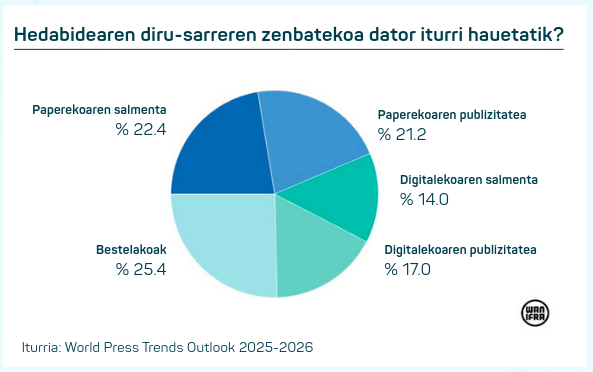
According to the WAN-IFRA World Press Trends Outlook 2025-202610 report, it is becoming increasingly clear that the media business, from an income point of view, is based on three pillars: print edition (sales and advertising), digital edition (subscriptions or partners and digital advertising) and other revenues (events, B2B -business to business- services, agreements with platforms, etc.). In recent years, paper revenues have been declining, but those of digital publishing have barely grown. Digital subscriptions have a slight upward trend, but digital advertising is fluctuating. Therefore, the third pillar has been the key to the balance of income. Other income in five years has increased from 13.2 per cent to 25.2 per cent.

According to the Journalism, media, and technology trends and predictions 202611 report by Nick Newman at the Reuters Institute, the majority of media managers surveyed (76%) are focused on content that feeds subscriptions and memberships. Renewed interest in the brand’s native advertising (64%) has also been detected. Another option that has attracted attention is that of public events (54%).
While improving and optimizing core products will be the priority in the future to generate revenue, the officials consulted by Nick Newman believe that it will not be enough and that they will have to develop new products and look for new sources. Among the new possibilities, they highlight the possibility of getting artificial intelligence platforms to pay for content.
The double challenge of artificial intelligence
In addition to its impact on misinformation and media mistrust, artificial intelligence poses a twofold challenge to the media. On the one hand, they will have to respond to the paradigm shift of the search. On the other hand, they will have to decide what they should develop and how they should use artificial intelligence.
According to the Journalism, media, and technology trends and predictions 202612 report, media executives expect a 43% reduction in search engine traffic in three years. In contrast, question-and-answer search, which understands questions asked in natural language and allows you to ask again about the answers, is gaining momentum and the number of non-clicked searches is increasing. It is not clear to what extent this is happening and what the evolution will be. According to data provided by Chartbeat for the above-mentioned Reuters Institute report, organic search traffic on 2,500 websites globally fell by 33 percent from November 2024 to November 2025 (38 percent in the United States of America versus 17 percent in Europe).

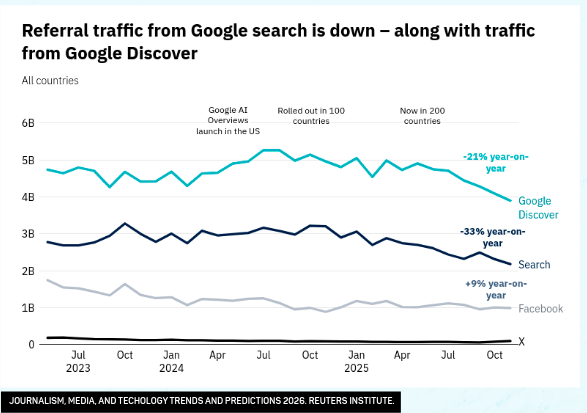
In addition, Chartbeat data shows a rapid increase in traffic coming from ChatGPT, although today the volume is very small compared to that generated by Google (500 times less and 1,300 times less compared to Discovery). But this trend indicates that AI search through chatbots is increasingly used, as well as finding news, and that in this environment few clicks are made to the original sources.
The other challenge relates to the application of artificial intelligence technology. In the last year, the use of artificial intelligence in newsrooms has increased. According to the WAN-IFRA World Press Trends Outlook 2025-202613 report, since the launch of ChatGPT, artificial intelligence has become a strategic priority for a growing number of media outlets. 93% of respondents plan to invest in artificial intelligence and automation by 2026 and 90% in data analysis and intelligence. These data coincide with those collected by Nick Newman of the Reuters Institute. Artificial intelligence technology is increasingly being used in the media. The vast majority (97%) consider it important to automate pre-production tasks (transcripts, metadata, etc.) and many have integrated it into content management sites in the last year. Using it for information collection (82%) and accelerating product programming and development (81%) is also important for most.

However, there is some disillusionment with artificial intelligence in the newsrooms, since very few managers (13%) recognize that the results or initiatives so far have been transformative.
The types of use have multiplied and interesting examples can be found. For example, studies by the New York Times to track large volumes of information or a tool called Djinn created by the Norwegian newspaper iTromsø to track government archives and documents. There are also dubious examples, such as the Washington Post’s automatic news podcasts, published with significant errors in the scripts. In the future, along with the development of artificial intelligence, one of the trends that is mentioned is the application of agent processes.
Trends in journalism
Given the impact of disinformation and artificial intelligence, according to the report by Nick Newman of the Reuters Institute, efforts are planned to strengthen certain lines of journalism: original research, local journalism, contextual analysis and human stories. At the same time, they foresee less effort in other areas: services, non-time-bound content and general news.
They have expressed their intention to invest in audiovisual content, mainly video content, but also podcasts. In this regard, the respondents have paid special attention to the platforms Youtube, Tik Tok and Instagram. An interesting trend is the use of vertical videos. The New York Times has added a new section to its app"s menu: Watch The Washington Post and CNN have done something similar. They have given importance to the vertical video space, giving space to the explanations and analysis of journalists. As tools for direct communication and engagement, these vertical videos represent an interesting path for the media.

in 2025, the phenomenon of content creators has been one of the main references in the world of media. Media managers are concerned about the importance that content creators have acquired. They believe that this ecosystem will take time and attention away from the content of journalism, and some fear that talent will be lost. To respond to this phenomenon, some will look for journalists who act as creators, while others will make alliances with creators or hire them directly.

Gender gap
Overcoming the gender gap is one of the urgent challenges facing the media. Women are underrepresented in the media, both in the directorates and in the informative content. Reuters Institute Women and leadership in the news media 2025: According to the report Evidence from 12 markets14, only 27% of media executives are women, although 40% of journalists are women. Compared to previous years, the number of women leaders has increased: in 2023 it was 22% and in 2024 it was 24%. There is still a long way to go towards equality.

The position of women in the news is much lower than that of men, despite being half the population. According to a 2025 report by The Global Media Monitoring Project15, only 26% of people in traditional media are women. In digital media, the percentage is slightly better: % 29. This report is produced every five years and, retrospectively, the latest data are worrying as progress has stalled. The authors of the report call for action. “Without women’s voices, there is no full narrative, no fair democracy, no shared future” (Article 12 of this yearbook analyzes the section of this study in Hego Euskal Herria).
References
Reporters without borders. (2025). 2025 Round-up. 2025, A deadly year for journalists: this is where hate and impunity lead. https://rsf.org/en/2025-deadly-year-journalists-where-hate-and-impunity-lead
Committee to Protect Journalists. (2025). Israel-Gaza War. Attacks on journalists across the region since October 7, 2023. https://cpj.org/issue/israel-gaza-war/
Reporters Without Borders. (2026). Trump’s Year of the Second Mandate: The President Will Walk the Road Toward Uniting Predators of the World’s Press Freedom. https://rsf-es.org/un-ano-del-segundo-mandato-de-trump-el-presidente-va-camino-de-unirse-a-los-peores-depredadores-de-la-libertad-de-prensa-del-mundo/
World Economic Forum. (2025). The Global Risks Report 2025. https://reports.weforum.org/docs/WEF_Global_Risks_Report_2025.pdf
Newman, Nic. (2026). Journalism, media, and technology trends and predictions 2026. https://reutersinstitute.politics.ox.ac.uk/journalism-media-and-technology-trends-and-predictions-2026
Arguedas, Amy Ross · Mukherjee, Mitali · Nielsen, Rasmus Kleis. (2025). Women and leadership in the news media 2025: Evidence from 12 markets.https://reutersinstitute.politics.ox.ac.uk/women-and-leadership-news-media-2025-evidence-12-markets
Macharia, Sarah · Dueñas Guzmán, Maximiliano · Molina, Rodrigo. (2025). Progress on Plateau. 30-Year Findings On Change In Gender Equality In and Trough the World News Media. https://whomakesthenews.org/wp-content/uploads/2025/12/GMMP2025-GlobalReport.pdf
1. https://rsf.org/en/2025-deadly-year-journalists-where-hate-and-impunity-lead
2. https://www.nuj.org.uk/resource/human-rights-day-2025-111-journalists-killed-this-year-say-ifj.html
3. http://Committee to Protect Journalists (CPJ)
4. https://ipi.media/on-international-day-to-end-impunity-for-crimes-against-journalists-ipi-calls-on-states-to-uphold-obligations-under-international-law/
5. https://wan-ifra.org/2026/01/world-press-trends-outlook-rising-three-pillar-revenue-model-fuels-industry-optimism/
6. https://rsf-es.org/un-ano-del-segundo-mandato-de-trump-el-presidente-va-camino-de-unirse-a-los-peores-depredadores-de-la-libertad-de-prensa-del-mundo/
7. https://www.nytco.com/press/ag-sulzberger-urges-journalists-keep-reporting-without-fear-or-favor/
8. https://reports.weforum.org/docs/WEF_Global_Risks_Report_2025.pdf
9. https://reutersinstitute.politics.ox.ac.uk/es/digital-news-report/2025/dnr-resumen-ejecutivo#ftn5
10. https://wan-ifra.org/2026/01/world-press-trends-outlook-rising-three-pillar-revenue-model-fuels-industry-optimism/
11. https://reutersinstitute.politics.ox.ac.uk/journalism-media-and-technology-trends-and-predictions-2026
12. https://reutersinstitute.politics.ox.ac.uk/journalism-media-and-technology-trends-and-predictions-2026
13. https://wan-ifra.org/2026/01/world-press-trends-outlook-rising-three-pillar-revenue-model-fuels-industry-optimism/
14. https://reutersinstitute.politics.ox.ac.uk/women-and-leadership-news-media-2025-evidence-12-markets
15. https://whomakesthenews.org/wp-content/uploads/2025/12/GMMP2025-GlobalReport.pdf